 |
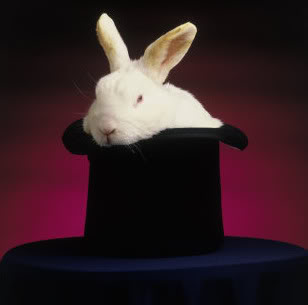
| The traditional "rabbit out of hat" trick. Although magic today is known for card tricks and escapism, this is a never dieing favorite that will forever be one of the first things we think of when someone says "magic trick". |
As long as there has been humanity, there has been the magic of illusion and escapism. Just to give a sense of how long magic has existed, over 4000 years ago there was a novel written, titled "Westcar Papyrus", that has mention of a magician preforming for a Pharaoh centuries before the book was even published.
Magic has been preformed all over the world, for quite sometime. It was a great source of entertainment, especially for Pharaohs and kings.
*In Europe, Reginald Scout wrote "The Discoveries of Witchcraft", in 1584, for those who were accusing magicians of witchcraft. Which, back then, would mean certain death.*
Before 1750, magic was mostly performed outside because magicians did not have theatres to play in. They performed mainly at fairs, market places, and on street corners. Since their space was so limited so was their act. They could only perform with what they could carry, or whatever the audience might have had on them.
Once fairs began to decrease in popularity, magicians moved to the big cities. There upper-class discoveries of this art form led to theatered magic shows. Which then spawned magicians joining other teams of various acts, in whats called a serial structured performance, known today as Vaudeville. Vaudeville theatre allowed magic to be mobile, and watched by changing audiences night by night, sparking the flourish of illusion as entertainment.
*Science was huge in the 1700-1800's, so in order to attract an audience magicians would use scientific terms in the act, or add in scientific lectures to the act.*
Movies took over Vaudeville in the 1930's, which hurt magicians badly. With no where to perform, they turned to night clubs and hotels. The huge difference between the two was that now, instead of performing for a different audience the same piece, they needed to create a new piece every night, to the same audience.
In the late 1900's, television became the new open door. A lot of people were skeptical that viewers wouldn't believe what they were seeing, but it turns out that broad casted magic was a huge hit. Especially seeing as that is how we mostly see it performed today.
Famous Magicians
 |
| Flier for Robert Houdin |
John Nevil Maskelyne, George Cooke: brought magic back to the stage when they permanently moved into the Egyptian Hall in London, in 1873.
Harry Kellar: first touring magician, most famous magician in the USA in 1884.
Howard Thurston: toured with Harry Kellar, in Kellars retirement in 1908, took his place as most famous magician.
Cardini: famous for his tipsy gentleman, reappearing card trick on Vaudeville.
P.A. Benjamin Rucker: aka Black Herman. African -American magician, famous for his buried alive trick, where he'd appear dead, be buried, and come back days later. Died on stage in 1934.
P.T. Selbit: used the first woman for a torture trick in 1921, the wooden box, and then cuts her in half. This caught on like a forest fire for magicians everywhere, believed to be so because of the women's suffrage uproar.
A.J. Cantu: first to make doves appear in a trick.
Channing Pollock: revised this trick, and became famous for doves appearing from thin air.
Dai Vernon: specialized in close up magic, and card tricks. He was a teacher to many magicians.
*Close-up magic is magic done for a small audience who can see everything.*
Mark Wilson: one of the first to air magic on TV.
Doug Hanning: Created "Doug Hanning's World of Magic", aired on 26. Dec. 1975, it was the highest rated magic special of its time.
"Wilson believed that magic needed three things to work on TV:
• Always have a live audience
• Never have the camera cut away during a trick.
• Let viewers know that they see exactly what the studio audience sees."
Doug Hanning: Created "Doug Hanning's World of Magic", aired on 26. Dec. 1975, it was the highest rated magic special of its time.
Milbourne Christopher: had the first nationally aired magic special.
Sigfried and Roy: German magicians who came to Las Vegas, and turned our rabbit in a hat, to a cheetah.
David Copperfield: brought the rock star edge to the world of illusion.
And for last, but not least, probably the two most famous magicians to ever exist:
Harry Houdini, born in Hungary as Erich Weiss in 1874. He moved to America as a baby. He took his stage name from an idol, Robert Houdin. He became professional at escapism and illusion at the age of 17. He had an obsession with psychic mediums in an attempt to regain communication with his mother. He died in 1926, on Halloween day.
Here he is performing one of his most famous escapes, hanging upside down in a straight jacket.
And Criss Angel, born Cristopher Sarantakos on 19.Dec1967 in Long Island New York. His biggest influence being Harry Houdini of course. Criss has been in love with magic all his life. He has a hit series Criss Angel: Mindfreak, which just ended it's sixth season and a Cirque Du Soleil show titled "Believe" in Las Vegas Nevada.
"Angel is the only magician to have won the Merlin Magician of the Year award twice: in 2001 and 2004. He holds the world records for longest time submerged underwater (24 hours), the longest body suspension (5 hours, 42 minutes), fastest time to perform the Metamorphosis illusion (under a second) and the fastest straight-jacket escape (2 minutes & 30 seconds)."
And has recently gained world record of most people to vanish in an illusion, making 100 people disappear.
He has surpassed his own idol in many ways, and has become the Houdini of our century.
Here he is duplicating Houdini's straight jacket escape in New Orleans, with a twist. Instead of a magicians jacket, he is using,not one, but two asylum approved straight jackets.
Sources:
"The World Of Theatre" by Mira Felner and Claudia Orenstein


